Feature 01
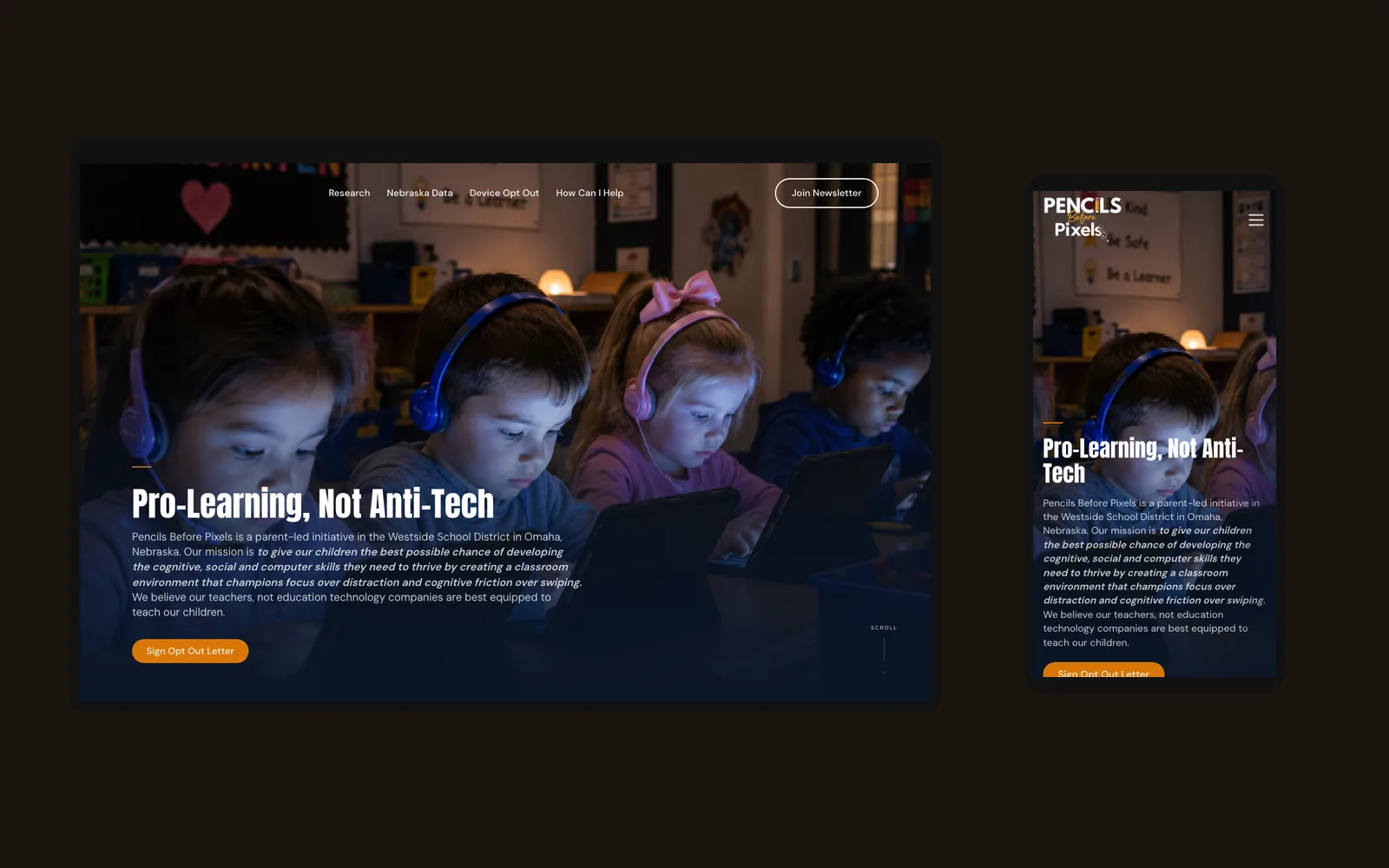
Advocacy homepage
The homepage introduces the parent-led mission and routes visitors into research, local data, and action without requiring them to know the jargon first.
Case study
Parent Advocacy Site — WD Awards Nominee
For Pencils Before Pixels, Adnan Studios designed and shipped a research-driven site for parents in Omaha’s Westside school district about how screens affect how kids learn—later recognized as a WD Awards nominee.
Parents in Omaha’s Westside school district wanted clear, research-based information about how classroom screens affect learning—and practical next steps such as device opt-out guidance. The story is emotional and political; the site had to stay credible, calm, and evidence-led rather than sensational.
Visitors include parents evaluating whether to act, plus educators and community members looking for data. The content spans research summaries, Nebraska/Westside data, resources, and opt-out information. Design needed to make long research readable on mobile while keeping primary actions (learn, opt out, help) obvious.
Zero Handoff means the same team that framed the UX in Figma stayed with the work through production detail—so Adnan Studios did not lose intent between design and engineering.
Discovery organized parent concerns into a journey: understand the issue, review research and local data, then take a concrete action. Content types—mission timeline, expert voices, resource library, opt-out—were mapped before visual design so the IA matched advocacy goals.
UX prioritized scannable sections with deep research available on dedicated routes. Anchors on the homepage let parents jump to mission, findings, resources, opt-out, and ways to help without drowning in a single infinite scroll of statistics.
UI used a clear typographic hierarchy for data-heavy pages, restrained color, and strong sectioning so charts and findings feel authoritative. The visual system was built to earn trust with school-board-adjacent audiences.
Zero Handoff kept design decisions aligned with what shipped on pencilsbeforepixels.org. Adnan designed in Figma and implemented the live advocacy site so research pages, CTAs, and mobile typography stayed coherent.
The site launched as the public home for Pencils Before Pixels. It was later listed as a WD Awards nominee (nominated for Website of the Day recognition on WD Awards—not described here as a win).
Pencils Before Pixels speaks to parents concerned about classroom screen time in Omaha’s Westside community. The site has to carry research, local data, and action paths without tipping into panic. Parents deciding whether to opt out of one-to-one devices deserve calm hierarchy, readable data, and clear next steps.
Content architecture separates mission, findings, Nebraska/Westside data, resources, and opt-out guidance so visitors can enter at different depths. A parent who only needs opt-out help should not be forced through an academic paper; a parent preparing for a board conversation should still find citable material.
The project was recognized as a WD Awards nominee. This case study deliberately does not call it a winner or claim Website of the Day as an award received. Nominee language is the accurate public status and should stay that way in SEO titles, body copy, and AI-facing summaries.
Recognition is useful social proof, but the primary product story remains the advocacy job: help parents understand how screens affect learning and what they can do next.
Data-heavy advocacy sites often break when design and implementation diverge—charts clip, mobile typography collapses, and CTAs drift. Designing in Figma and shipping in Next.js on pencilsbeforepixels.org kept those surfaces coherent. The live site is the source of truth for visual outcome.
Feature 01
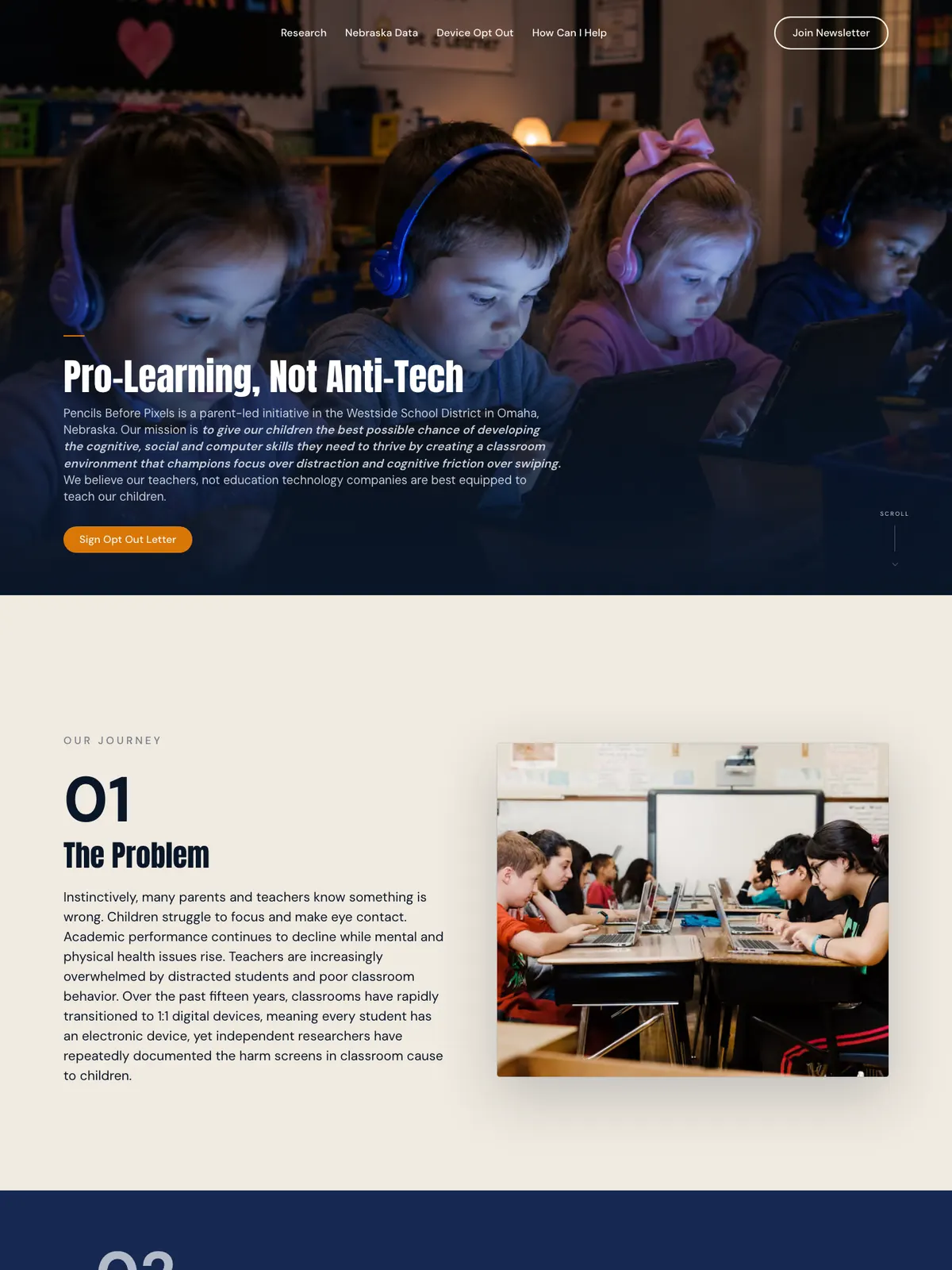
The homepage introduces the parent-led mission and routes visitors into research, local data, and action without requiring them to know the jargon first.
Feature 02
Research sections translate dense education-technology findings into parent-readable structure while preserving enough rigor to remain citable.

Feature 03
Nebraska and Westside-oriented data and a resource library help parents move from national talking points to local context.
Feature 04
Clear paths for device opt-out information and ways parents can help keep the site oriented toward action, not only awareness.

Stated as plain sentences so search engines and AI tools can quote them accurately.
Pencils Before Pixels published a parent-facing site about how screens affect how kids learn, focused on Omaha’s Westside school district community.
The website was recognized as a WD Awards nominee (Website of the Day nomination listing)—not described as a winner.
Live research, local data, resources, and opt-out paths shipped on pencilsbeforepixels.org.
Zero Handoff delivery kept data-heavy pages readable on mobile from Figma through production.
“The site finally gives Westside parents research and next steps in one place—without the panic.”
No. Pencils Before Pixels is described here only as a WD Awards nominee. It should not be called a winner or “Website of the Day” recipient.
Primarily parents in Omaha’s Westside school district community, plus others seeking research-based information on classroom screen time and device opt-out options.
A research-driven advocacy website covering mission, findings, Nebraska/Westside data, resources, privacy/terms, and parent action paths.
https://www.pencilsbeforepixels.org/
Book a call on Calendly or review packages—same Zero Handoff studio from Figma to production.